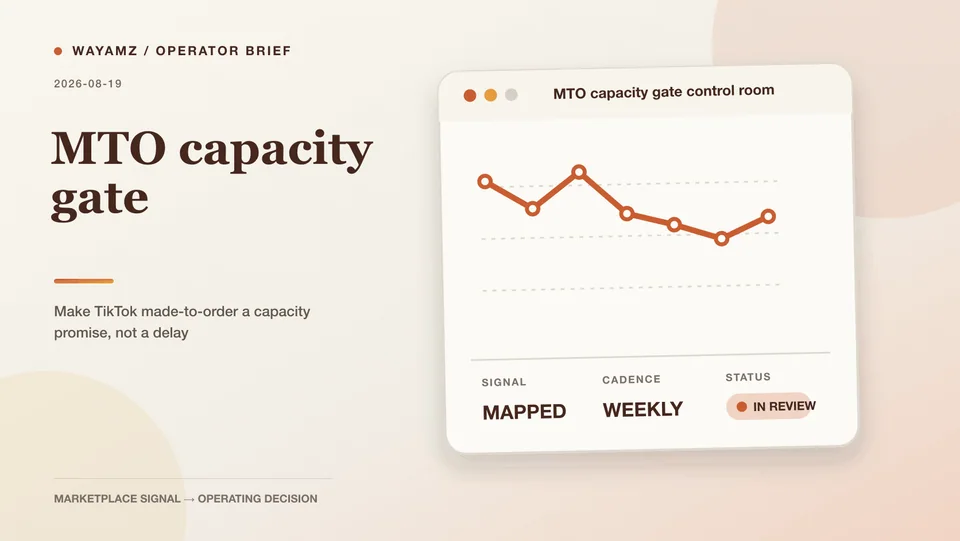
Make TikTok made-to-order a capacity promise, not a delay
TikTok Shop’s MTO flow gives eligible U.S. sellers 3–14 business days to produce selected new listings. Gate capacity, scans, returns, and Amazon spillover first.
By WAYAMZ Team
TikTok Shop’s U.S. made-to-order flow can give eligible sellers more time to produce selected products after purchase. For an Amazon operator, that sounds like a way to test demand without stocking every unit in advance.
The opportunity is real only when the longer handling time is treated as a capacity promise. It does not erase material lead times, quality failures, carrier cutoffs, customer expectations, or inventory already committed to Amazon. A listing can accept an order long before the operation can reliably create a sellable unit.
Distinguish MTO from every other delay
TikTok’s current MTO guidance describes a 3–14 business-day handling time for qualified sellers and eligible categories. It applies to new listings, and an existing listing cannot simply be converted. Sellers can set handling time at SKU level where the feature is available.
The same guidance says MTO is not for products customized to an individual buyer and that returned goods should be resellable. That separates the program from personalization, pre-ordering, and using a long promise to hide a backorder.
Write a one-sentence operating definition for every candidate SKU: produced from an approved standard specification after purchase, within a declared handling window, and capable of returning to sellable inventory if unopened and undamaged. If the product cannot meet that definition, use the workflow and policy designed for its actual order type.
Confirm the live shop and listing path
TikTok’s eligibility documentation can change, and the account interface is the operative control. Current U.S. guidance lists shop-performance and account conditions in addition to eligible products. Verify them in Seller Center before forecasting revenue or publishing a launch date.
Save evidence of the shop status, category, listing creation flow, selected handling time, and approval. Confirm that the control is attached to the intended SKU rather than only the product family. Do not copy a secondary article’s threshold into a permanent SOP when TikTok’s official page or the live account shows something different.
Start with a small number of new SKUs. One standard bill of materials, one production route, and one returns disposition make the first test easier to diagnose. MTO is not a cure for a catalog that cannot identify which version was ordered.
Build a sellable-capacity envelope
Begin with demonstrated sellable output, not theoretical machine speed. Subtract changeovers, scrap, quality holds, rework, maintenance, labor gaps, and material shortages. Reserve capacity already promised to wholesale, DTC, and Amazon replenishment.
Convert the remainder into a daily order cap by SKU. Use the slowest constrained step, then apply a buffer for variation in yield and arrival mix. If multiple SKUs share one mold, line, component, or approval station, cap the shared resource rather than pretending each SKU owns the full capacity.
Track orders by promised ship date and required production date. A simple board should show units accepted, materials allocated, work released, quality passed, packed, handed to carrier, and scanned. Stop or reduce exposure when the queue crosses the buffer; a longer stated window should not become permission to keep selling into a known miss.
Bind handling time to the first carrier scan
TikTok’s fulfillment guidance links MTO dispatch expectations to the configured handling time and a subsequent business-day handoff. The practical endpoint is not “label printed.” It is a valid carrier event that the platform and customer can observe.
Work backward from carrier pickup schedules, weekend rules, holidays, warehouse cutoffs, and the time needed to correct invalid addresses or failed quality checks. Choose the customer-facing handling time from a high-confidence path, not the average factory cycle.
Create alerts before the promise is endangered: materials not allocated, work not started, quality not passed, pickup missed, or tracking without a scan. Give each alert an owner and a latest safe action. Cancellation, replacement, or customer communication should be an explicit exception workflow, not a late improvisation.
Protect returns and Amazon availability
Design the SKU so a return can be inspected, graded, and put back into the appropriate sellable or unsellable state. Record the order, production lot, specification, packaging condition, reason, and disposition. Do not assume every returned unit can be resold merely because the program requires a resellable product design.
Keep TikTok’s initial MTO allocation separate from Amazon safety stock. Shared materials may be acceptable, but a viral order spike should not silently consume components required for an Amazon restock. Define channel priorities, reservation rules, and the person authorized to change them.
Expand only after the test produces stable evidence: on-time scans, cancellation rate, first-pass yield, labor minutes, return disposition, contribution margin, and impact on Amazon in-stock rate. Revenue without the capacity and portfolio costs can make an unstable program look successful.
The Operator Read
Made-to-order creates a useful demand-validation path when a standard product can be produced predictably after purchase. The extra handling time is not inventory and is not operational forgiveness.
Confirm the live eligibility rules, launch only new listings that fit the program, cap orders at demonstrated sellable capacity, and manage the promise through the first valid carrier scan. Keep returns and Amazon safety stock visible from day one.
The operator advantage is not accepting more orders. It is knowing exactly how many promises the system can keep before the next one is sold.
The Operator Brief
One email a week, operator's cut.
The week's sharpest Amazon signals from the journal — policy changes, fee math, and the data reads worth acting on. No spam, unsubscribe anytime.