
Prime Day moved into June. Your Amazon calendar needs to move now
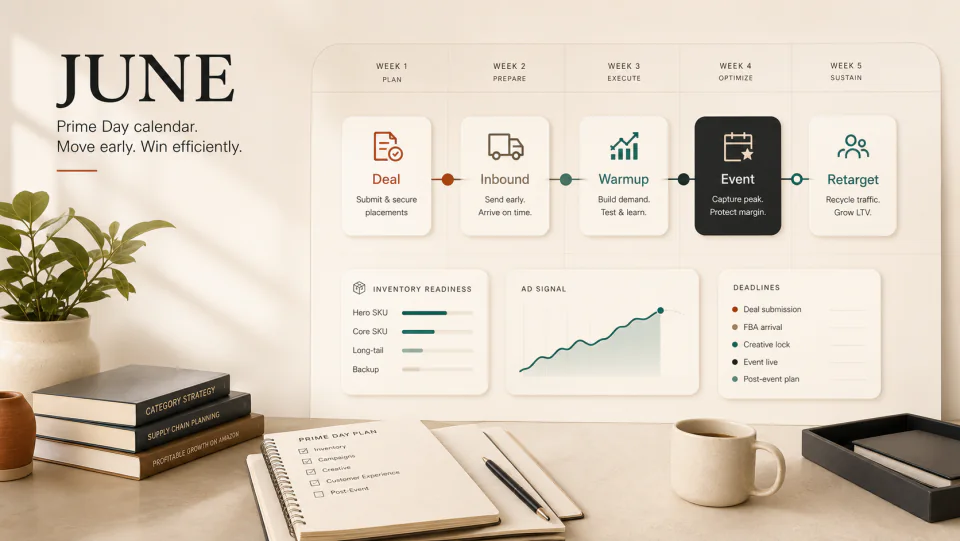
A June Prime Day compresses the seller calendar. Deals, FBA arrival timing, PPC warmup, and post-event retargeting need to be pulled forward together.
By WAYAMZ Team
A June Prime Day changes the operating calendar.
Many sellers are mentally trained for a July event. That rhythm leaves more room for deal setup, inventory movement, campaign testing, and creative cleanup. When the event window moves earlier, every unfinished task gets compressed into the same few weeks.
The risk is not only missing a deadline. The risk is making rushed decisions because the calendar was never rebuilt.
Start With The Account-Specific Dates
Prime Day planning should begin inside Seller Central.
Confirm the account’s deal submission window, FBA arrival guidance, coupon timing, promotion rules, and any inventory constraints visible in the account. External calendars are useful for orientation, but the account view is the operating truth.
Once those dates are confirmed, work backward.
The mistake is treating deals, inventory, ads, and creative as separate workstreams. They are linked. A deal that wins placement without inventory creates stockout risk. Inventory that arrives without ad coverage may not get the traffic curve it needs. Ads that scale without offer readiness can burn budget before conversion catches up.
Inventory Comes First
For Prime Day, the hero SKU list should be shorter than the wish list.
Choose the products that deserve traffic, have enough supply, and can hold margin after discount, ad spend, and fulfillment fees. Then rank them by operational confidence:
- Strong: enough inventory, strong listing, stable reviews, clean margin.
- Watch: good product, but inventory or margin needs active control.
- Risk: weak supply, uncertain conversion, or margin too thin for aggressive spend.
The risk bucket should not receive the same plan as the strong bucket.
If inbound timing is tight, decide now which SKUs get protected and which SKUs get allowed to sell through more slowly.
PPC Warmup Starts Before The Event
Prime Day traffic does not behave like a normal week.
Shoppers browse early, compare more, add to cart, and wait for deal confidence. That means campaign structure should be ready before the event window. Branded defense, category coverage, retargeting audiences, and hero ASIN budgets all need a pre-event role.
A simple budget structure works:
- Pre-event: defend and warm up the highest-intent audiences.
- Event window: concentrate budget on proven hero SKUs and deal-backed terms.
- Post-event: retarget visitors, clean up inefficient traffic, and move remaining inventory with discipline.
The exact percentages depend on the account. The principle does not: do not spend the whole budget in panic mode during the sale.
Creative And Listing Readiness Matter
Prime Day amplifies weak pages.
Before traffic spikes, inspect the main image, title, price display, coupon clarity, review posture, A+ content, and mobile scan path. A small listing weakness can become expensive when CPC rises and shoppers compare faster.
Creative should be built around the reason to buy now, not generic brand language. The best event creative answers one question: why is this SKU worth choosing during a crowded promotion window?
Do The Margin Check Before The Deal
Prime Day can create beautiful revenue and ugly profit.
Before approving a discount, rebuild contribution margin with the current fulfillment fee, expected ad cost, coupon or deal cost, return risk, and any inventory cleanup goal. A SKU with strong conversion may still be a weak event candidate if the offer only works at a loss.
The best Prime Day plan has different jobs for different SKUs. Some products are built for profit. Some are built for customer acquisition. Some are built to clear aging inventory. Mixing those goals creates confusion when the results arrive.
Assign the job before the sale starts.
The job also determines how the team reads results. A customer-acquisition SKU may be allowed to run lower margin if repeat purchase or brand expansion justifies it. A profit SKU needs stricter ad gates. A clearance SKU should be judged by cash recovery and storage relief, not by rank vanity.
The Operator Read
An earlier Prime Day rewards teams that can move the calendar without losing discipline.
Do not simply pull every task forward and hope the team keeps up. Rebuild the plan around gates: account deadlines, inventory confidence, listing readiness, PPC warmup, event execution, and post-event cleanup.
The sellers who benefit from Prime Day are not always the ones with the biggest discount. They are the ones whose operations are ready when traffic arrives.
If June is the window, May is the operating month.
The Operator Brief
One email a week, operator's cut.
The week's sharpest Amazon signals from the journal — policy changes, fee math, and the data reads worth acting on. No spam, unsubscribe anytime.