
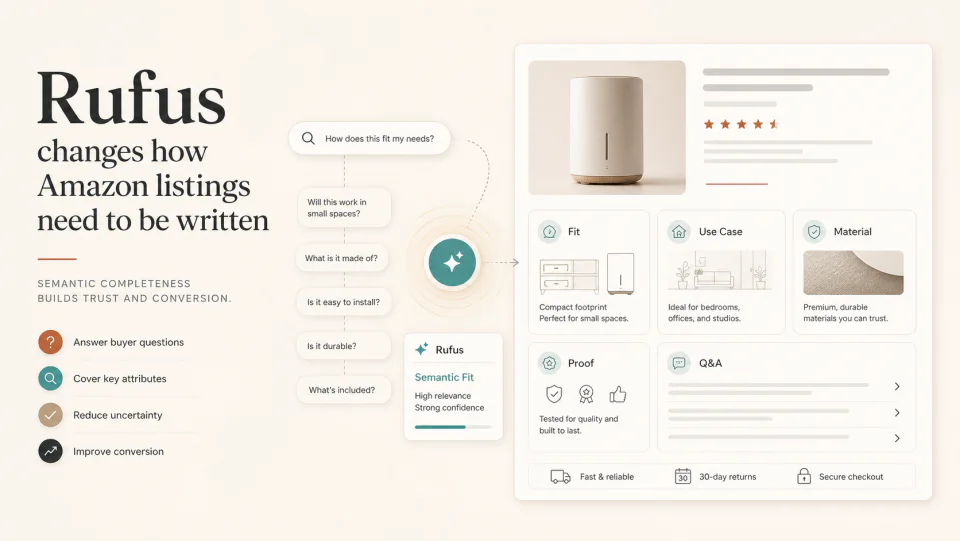
Rufus changes how Amazon listings need to be written
Amazon's AI shopping assistant makes semantic completeness more important. Listings need to answer buyer questions clearly, not just repeat keywords.
By WAYAMZ Team
Rufus changes the writing job.
For years, many Amazon listings were built around keyword coverage first and buyer clarity second. The result was predictable: titles packed with terms, bullets that repeated the same claims, and A+ content that looked attractive but did not answer the hardest questions.
That approach was already weakening. AI-assisted shopping makes the weakness more visible.
When a buyer asks a product question through an AI shopping assistant, the listing has to be understandable as a whole. The system needs to know what the product is, who it is for, what problem it solves, what attributes matter, and what tradeoffs a shopper should expect.
That is semantic completeness.
Keyword Coverage Is Not Enough
Keywords still matter. Amazon cannot match demand to a product if the listing never uses the language buyers use.
But keyword density is a poor substitute for meaning. Repeating a term five times does not prove the product fits the use case. A listing that says “waterproof” but never explains where, how, or under what conditions is leaving ambiguity for both the buyer and the machine.
The better question is: after reading the listing, could a buyer and an AI assistant explain the product in the same way?
If the answer is no, the listing needs work.
Build Around Buyer Questions
Start with the questions buyers actually ask:
- Will this fit my use case?
- Is it compatible with my existing product?
- What size, material, or capacity should I choose?
- Why is this different from the cheaper option?
- What problem does it solve better than the category average?
- What might disappoint me after purchase?
Those questions should shape the title, bullets, image stack, A+ content, comparison chart, and Q&A.
This is where many listings are thin. They include product attributes, but they do not connect those attributes to buyer decisions.
Make Every Content Block Do A Job
The title should identify the product clearly and include the strongest buyer-relevant differentiator.
The first bullet should explain the main use case. The next bullets should handle proof, compatibility, material, size, care, or risk reduction. The image stack should answer what a shopper would normally zoom in to inspect. A+ content should compare, educate, or remove hesitation.
Q&A should not be treated as clutter. It is a structured place to answer the exact questions that AI-assisted search may care about.
The listing should not feel longer. It should feel more complete.
What To Measure
Do not optimize for “Rufus readiness” as a vague score.
Measure outcomes:
- CTR on core and long-tail queries.
- Conversion rate after content changes.
- Search Query Performance movement by query group.
- Customer question volume after the update.
- Return reasons tied to misunderstood attributes.
If the listing becomes clearer, you should see fewer mismatched expectations and stronger movement on queries where the product genuinely fits.
The Content Gaps To Fix First
Start with the places where buyers hesitate.
For many ASINs, the gap is not the main keyword. It is compatibility, sizing, materials, care instructions, installation, safety, warranty, or what is included in the box. These details may feel boring, but they help both the shopper and the AI assistant understand fit.
Image text and A+ modules should reinforce the same answers. If the bullet says “fits small apartments” but the image stack never shows scale, the listing is incomplete. If the title mentions a material but the A+ content never explains why it matters, the claim is underused.
Semantic optimization is not a writing trick. It is consistency across the page.
That consistency also helps the human buyer. The shopper may never know whether Rufus influenced the journey, but they will notice when the page answers the next question before they have to leave the listing. Clear answers reduce comparison shopping. Clear fit reduces returns. Clear tradeoffs make the product feel more trustworthy.
The Operator Read
Rufus does not make old SEO irrelevant. It raises the standard.
A listing now has to be readable by the buyer, structured for Amazon, and complete enough for AI-assisted discovery. That means fewer keyword dumps and more precise product truth.
The best listing teams will not ask, “How many keywords did we include?”
They will ask, “What question does this page answer better than the competing result?”
That is the writing standard for the next version of Amazon search.
The Operator Brief
One email a week, operator's cut.
The week's sharpest Amazon signals from the journal — policy changes, fee math, and the data reads worth acting on. No spam, unsubscribe anytime.