
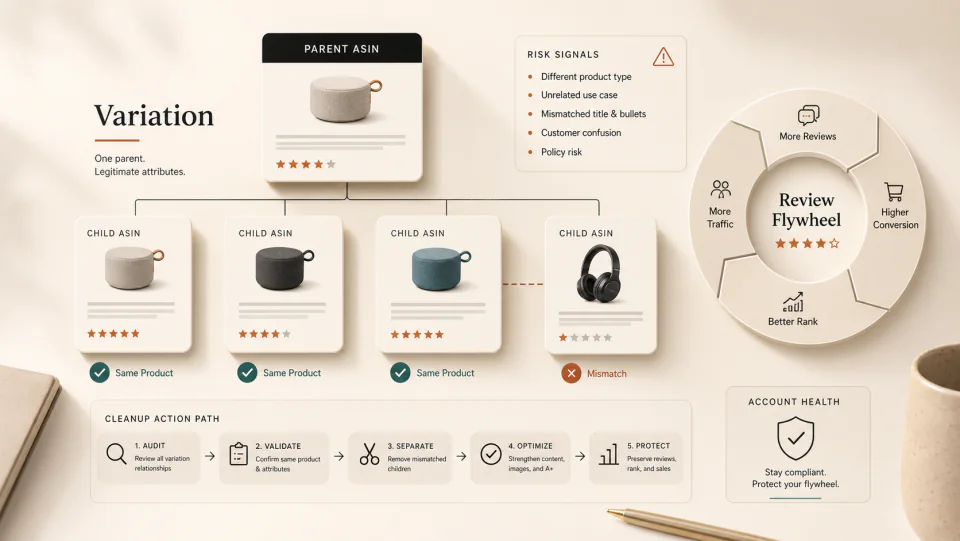
Audit Amazon variations before enforcement hits the review flywheel
Variation abuse is not a clever conversion tactic. If unrelated child ASINs are grouped to share reviews, enforcement can split the family and damage rank, reviews, and ads.
By WAYAMZ Team
Variation structure is not a back-office detail. It can decide whether a product keeps its review flywheel.
Amazon’s variation policy is straightforward in principle: child ASINs should represent the same product with legitimate attribute differences, such as size, color, scent, count, or another accepted theme for the category.
The problem is that many catalogs were built around a looser idea: if two products are close enough, group them. If one product has reviews, let the weaker product borrow the trust. If the parent family converts better, keep expanding it.
That logic creates risk.
What Variation Abuse Looks Like
The most common pattern is grouping products that are not truly the same item.
A phone case and a charging cable are not a clean variation family. Two different product types under a vague “style” theme are not a clean variation family. Child ASINs with titles that describe substantially different products are not clean. A buyer who says “this is not what I selected” is a warning signal.
The issue is not whether the grouping once helped conversion. The issue is whether the family can survive a policy review.
Why Enforcement Hurts So Much
When a risky variation family is split, the damage can be wider than the catalog team expects.
Reviews may no longer support the same child ASINs. BSR history can reset or weaken. Advertising learning may become less useful because the traffic path changes. A listing can lose the comparison advantage that made the parent family convert.
In more serious cases, variation problems can connect to account-health warnings or listing suppression.
That is why variation compliance should be reviewed before a major traffic event, not after a forced split.
The Audit Questions
Start with every parent ASIN that matters to revenue.
Ask four questions:
- Are all child ASINs truly the same product?
- Is the variation theme allowed and logical for the category?
- Do the child titles, images, and attributes make the relationship obvious?
- Would a buyer feel misled if they moved between child options?
If the answer is weak, flag the family.
Then look at buyer signals. Return reasons, review language, customer questions, and support tickets often reveal variation confusion earlier than a policy notice.
Proactive Cleanup Is Usually Cleaner
No seller enjoys separating a parent family that has been carrying conversion.
But proactive cleanup gives the team more control. You can decide which ASIN should hold the strongest review base, how to rebuild content, where to redirect ad spend, and how to sequence the change before a launch or promotion.
Forced cleanup tends to happen on Amazon’s timeline.
That is the difference between an operating decision and a fire drill.
Where To Start If The Catalog Is Large
Do not audit the whole catalog randomly.
Start with the parent ASINs that carry the most reviews, the most ad spend, or the most Prime Day exposure. Then look for families that grew too quickly, families built around a vague “style” theme, or families where one child looks like a different product when viewed on mobile.
The mobile check matters. If a shopper cannot understand the variation relationship from the title, image, and selector, the family may already be creating confusion.
Document the risk level before changing anything. Some families need immediate cleanup. Others need better titles, attributes, or images. A few may be defensible as-is.
The documentation matters because variation cleanup can affect advertising, inventory, and reporting at the same time. When the team changes a parent family, campaign targets, storefront links, A+ comparison modules, and external traffic links may all need to be checked. Treat the cleanup like a launch change, not a catalog typo.
That extra coordination is cheaper than discovering broken traffic after the family has already been split.
The Operator Read
A variation family should help the shopper choose between real options. It should not be a review-sharing shortcut.
Before the next traffic spike, audit the catalog. Find the parent ASINs where the children are only loosely related. Clean up the ones that would be hard to defend.
The short-term conversion lift from a messy family is not worth losing the review flywheel when enforcement arrives.
The Operator Brief
One email a week, operator's cut.
The week's sharpest Amazon signals from the journal — policy changes, fee math, and the data reads worth acting on. No spam, unsubscribe anytime.