
What the Amazon seller ad boycott actually changed
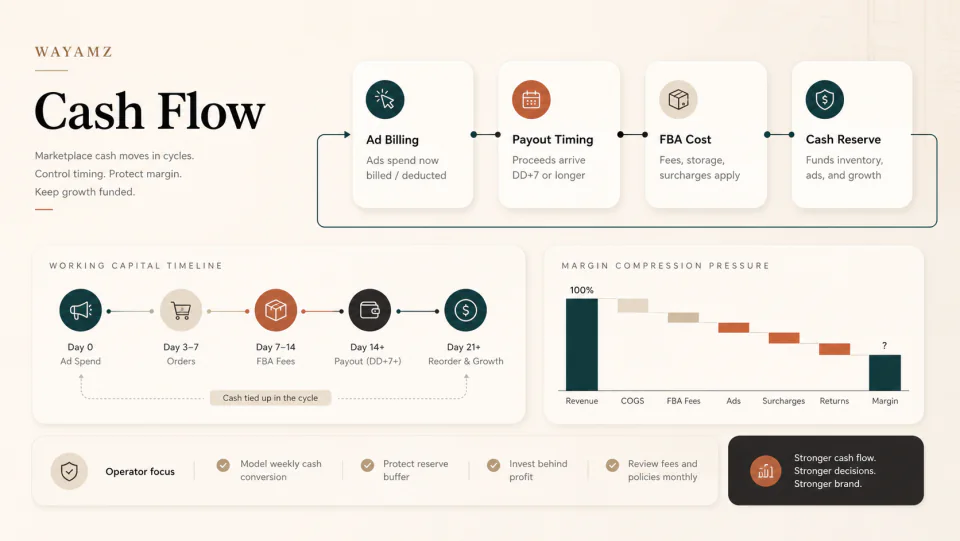
Large Amazon sellers protested ad billing, payout timing, and fulfillment surcharges. The visible concession matters, but the deeper cash-flow problem still has to be modeled account by account.
By WAYAMZ Team
The seller ad boycott made one thing visible: many Amazon operators are no longer arguing about one fee at a time. They are arguing about the cash-flow shape of the whole account.
The reported protest focused on three pressure points: longer payout timing, advertising bills being deducted from seller proceeds instead of credit cards, and a fuel or logistics surcharge on fulfillment fees. Amazon appears to have slowed one of those changes, but the broader math did not go away.
For sellers, that distinction matters. A delay is not the same as a reversal. A concession on ad billing does not fix a payout reserve. And a fee that looks small as a percentage can still erase the thin layer of contribution margin that was funding advertising, inventory, and the next product launch.
What Actually Changed
The most visible change was around advertising payment timing. Sellers who relied on credit cards to pay for Amazon Ads were not only using rewards points. They were also using payment float: the gap between when ads were charged and when the card bill was due.
If Amazon deducts more ad costs from seller proceeds, that float shrinks. For a brand spending five or six figures a month on PPC, the lost working-capital cushion can be meaningful even before the campaign results change.
The practical takeaway: ad billing belongs in the cash-flow model, not only in the ad dashboard.
What Did Not Change Enough
The bigger issue is that several cash events can now stack on top of each other.
Inventory invoices still arrive before sales are collected. Amazon payout timing may hold cash longer than sellers expect. Fulfillment fees can rise while price competition prevents a clean pass-through. PPC costs still need to be paid before the full payback of the cohort is clear.
That is how a profitable account starts feeling short on cash.
The P&L can say the business is alive while the bank account says the next reorder is constrained.
Do Not React By Cutting Ads Blindly
Turning off ads across the board is usually too blunt. It hands some query coverage to competitors and can slow the flywheel that produces organic rank.
The better response is campaign triage.
Put campaigns into four buckets:
- Defense: branded terms and hero ASIN coverage that protects existing demand.
- Profitable growth: campaigns that still clear contribution margin after updated fees.
- Testing: controlled spend for new terms, launches, or seasonal demand.
- Maintenance drag: spend that keeps revenue visible but no longer clears margin or search-share goals.
The fourth bucket should be challenged first. The first bucket should be protected unless the account is in emergency cash mode.
What Cross-Border Teams Should Rebuild
For US-China brands, the cash cycle is usually longer than the Amazon dashboard suggests. Supplier deposits, production windows, freight timing, domestic receiving, and FBA check-in all happen before the account sees the full return from the ad click.
That means a small platform change can travel backward through the whole supply chain. If payout timing gets longer, the Shenzhen team may need earlier purchase-order visibility. If ad float shrinks, the US operator may need stricter budget gates before approving a launch push. If fulfillment fees rise, finance needs to update price floors before the PPC team scales.
The fix is not complicated, but it needs discipline: one shared cash calendar, one weekly margin view, and one rule for when spend gets paused, protected, or reallocated.
The Operator Read
The boycott did not solve the platform economics question. It simply made the tension easier to see.
Amazon sellers should now treat cash conversion as a weekly operating metric. Not monthly revenue. Not blended ACOS. Weekly cash conversion.
That means knowing how many days pass between the ad click, the inventory cost, the fulfillment charge, the payout, and the next reorder. It also means revisiting credit lines, reserve buffers, price floors, and campaign structure before the next policy date arrives.
Margin pressure is not only a finance problem. It changes which products deserve traffic, which launches deserve inventory, and which campaigns should be allowed to keep spending.
The cleanest accounts will not be the ones with the loudest protest. They will be the ones that update the operating model before the next squeeze.
The Operator Brief
One email a week, operator's cut.
The week's sharpest Amazon signals from the journal — policy changes, fee math, and the data reads worth acting on. No spam, unsubscribe anytime.