
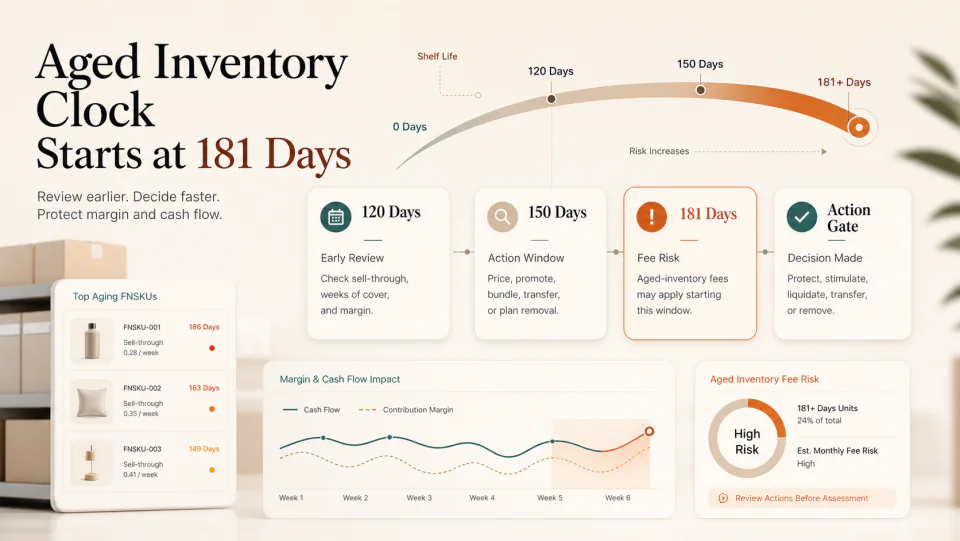
Amazon's aged-inventory clock now starts at 181 days
The old mental model of a 270-day safe zone is too slow. Sellers need to review inventory at 120, 150, and 181 days before storage fees turn a slow ASIN into a margin leak.
By WAYAMZ Team
The most expensive inventory mistake is usually made months before the fee appears.
For years, many sellers trained their teams around a simple rule: keep an eye on inventory before it gets close to 270 days. That rule is too slow for the current FBA environment. Once aged-inventory pressure starts earlier, the operating calendar has to move earlier too.
The right question is not “what do we do with inventory at 181 days?”
The right question is “why did no one make a decision at 120 or 150 days?”
Aged Inventory Is Not Just A Storage Fee
Aged inventory hurts in layers.
First, it traps cash. Every unit sitting in FBA is money that cannot be used for the next purchase order, a launch, a supplier deposit, or an ad test.
Second, it consumes space in the account’s operating model. The team keeps reporting on it, repricing it, forecasting it, and explaining why the sell-through did not recover.
Third, it can begin adding storage or aged-inventory fees that make the unit economics worse each month.
By the time a fee shows up, the SKU has usually been telling the same story for a while.
Move The Review Calendar Earlier
The useful review points are 120 days, 150 days, and the monthly assessment window.
At 120 days, the SKU still has options. You can adjust price without looking desperate. You can test a coupon. You can build a small Sponsored Products push around the highest-intent query. You can move units through a bundle or off-Amazon channel if the brand has one.
At 150 days, the decision should get sharper. If the product is not recovering on sell-through, a slow discount often costs more than a decisive clearance. The team should know whether the goal is margin recovery, cash recovery, rank support, or clean removal.
At 181 days, the account should not be discovering the problem. It should be executing the chosen path.
Watch FNSKUs, Not Only Parent ASINs
Parent-ASIN reporting can hide the weak unit.
A color, size, pack count, or style variant can age quietly while the parent looks fine. That matters because inventory fees and sell-through pressure are often felt at a more granular level than the brand’s top-line dashboard suggests.
For apparel, beauty, home, and accessory sellers, this is where inventory discipline gets real. One variant can create storage exposure, cash drag, and operational noise even while the hero variant is healthy.
The weekly inventory review should include FNSKU-level aging, weeks of cover, sell-through trend, and contribution margin after expected fees.
The Actions Need Names
“Monitor” is not an action.
Each slow SKU should be assigned one of five decisions:
- Protect: keep because rank, seasonality, or strategic placement justifies the hold.
- Stimulate: use price, coupon, PPC, or content changes to move demand.
- Transfer: route inventory into another channel if the brand has a better path.
- Liquidate: recover cash with a clear margin expectation.
- Remove: stop paying storage for a product that no longer deserves space.
The goal is not to avoid every fee. Sometimes a fee is acceptable if the inventory supports a strategic launch or seasonal curve. The problem is paying fees because no one made a decision.
Tie The Review To Replenishment
Aged inventory and low inventory are often managed by different people, but the decisions are connected. The same catalog can have one variant aging out while another variant risks stockout. If the team only looks at parent-ASIN health, both problems can hide in the average.
Review slow inventory before approving the next purchase order. Ask whether the next reorder should be smaller, whether the variant mix should change, whether a weak color or size should be discontinued, and whether the hero SKU deserves more cash instead.
This is where inventory work becomes growth work. Cleaner stock allocation gives the ad team better products to push and gives finance a clearer view of which ASINs deserve capital.
The Operator Read
Amazon inventory management is becoming less forgiving of lazy calendars.
The old 270-day comfort zone encouraged teams to wait. A tighter aged-inventory window forces teams to treat aging as a weekly operating issue, not a back-office cleanup project.
If a SKU reaches 181 days with no plan, the process failed earlier.
Move the review forward. Make the decision visible. Tie every slow unit to a named action. That is how aged inventory stops being a surprise fee and becomes a managed tradeoff.
The Operator Brief
One email a week, operator's cut.
The week's sharpest Amazon signals from the journal — policy changes, fee math, and the data reads worth acting on. No spam, unsubscribe anytime.