
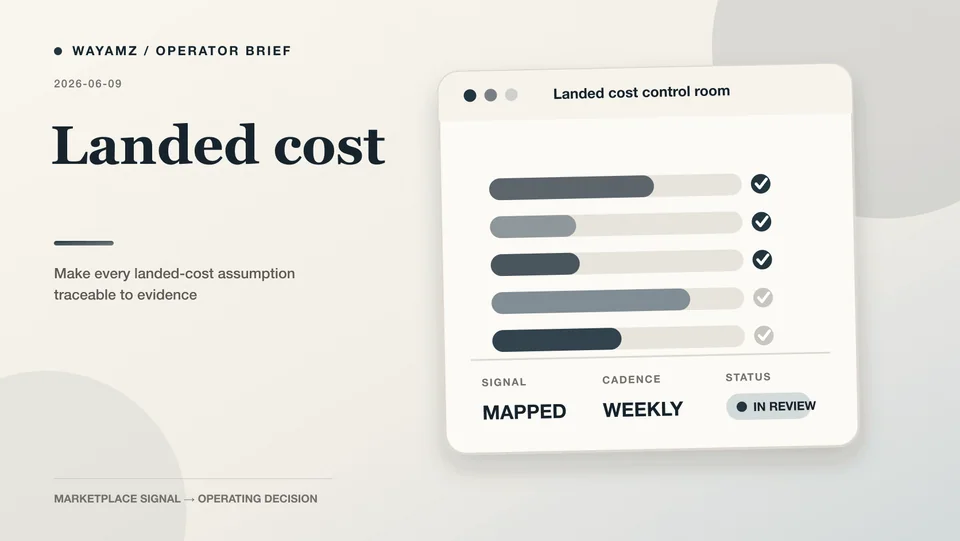
Make every landed-cost assumption traceable to evidence
Margin models fail when duty, freight, fees, and importer assumptions cannot be traced. Build a landed-cost file that finance and operations can defend.
By WAYAMZ Team
Most landed-cost sheets look precise.
That does not make them true.
A model can carry six decimal places while the duty rate came from an old product, freight was divided by unit count instead of volume, and the supplier’s DDP price hides who actually imported the goods.
The problem is not spreadsheet technique. It is evidence. Every material cost assumption should connect to a document, an owner, and a date.
Separate the cost stack
Do not hide landed cost in one imported number.
Break out product cost, packaging, tooling allocation, inspection, origin handling, international freight, insurance, duty, brokerage, port or parcel fees, domestic transfer, prep, inbound placement, and marketplace fulfillment costs.
Some costs belong to the unit. Others belong to a shipment, carton, weight, volume, purchase order, or sales period. Document the allocation rule and use the driver that reflects how the cost is incurred.
This structure lets operators see whether a margin change came from the factory, trade lane, customs treatment, inventory placement, or Amazon fee layer.
Link every assumption to its source
Put evidence next to the number.
Factory cost should link to the current purchase order or contract. Freight should link to a quote and later to the final invoice. Duty should connect to the entry record and the classification basis. Marketplace fees should use current reports and the product’s actual dimensions and weight.
Record the currency, exchange rate source, effective date, supplier, route, and responsible entity. If an adviser approved a treatment, save the advice and its assumptions.
A number without a source may still be useful for planning, but label it as an estimate. Do not let estimates quietly become accounting truth.
Keep expected and actual views
The purchase decision needs an expected landed cost. The operating review needs the actual one.
Preserve both. At the purchase order, estimate every component using the best current evidence. After the shipment closes, replace estimates with invoices, customs records, warehouse charges, and actual received quantity.
Calculate variance by component. A total variance of five percent can hide a favorable factory price and a damaging freight or duty miss. Investigate the driver, not only the net result.
Reconcile quantity as carefully as price. Damaged units, inspection rejects, carton shortages, samples, and warehouse receiving differences change the number of sellable units absorbing shipment cost. Allocating freight across the purchase-order quantity can understate the real cost of every unit available for sale. Preserve both ordered and received quantities, then explain the loss between them. That bridge can expose a supplier-quality problem that a conventional landed-cost sheet hides inside a small variance.
Use batch-level actuals when costs or routes change materially. One blended average can make old inventory look unprofitable and new inventory look healthier than it is.
Challenge importer and valuation assumptions
Shipping terms do not answer every compliance question.
Confirm which entity is importer of record, who owns the goods at each stage, what value was declared, and which charges were included. Ask qualified customs and tax professionals to review classifications or structures that are unclear or material.
Operators should not choose a tariff code because it improves margin. They should assemble accurate product information and evidence so the correct treatment can be determined.
Document uncertainty as an exception. Pricing and reorder decisions should see the possible range until the issue is resolved.
Feed the model into decisions
A landed-cost file should change behavior.
Use it to set price floors, promotion limits, reorder quantities, sourcing priorities, and SKU stop-loss rules. Connect margin views to inventory batches where practical. Review cost movement before increasing ad spend or approving a deal.
Set thresholds for investigation. A freight, duty, or fee variance that changes contribution margin materially should create an assigned action, not a footnote.
Refresh high-volume products monthly and the broader catalog at each new purchase order. Old cost assumptions compound quickly when traffic scales.
The Operator Read
Landed cost is not one number. It is an argument supported by records.
Separate the stack, link every material input to evidence, reconcile estimates with actual shipments, and show uncertainty before the team commits price or inventory. Use specialists where classification, valuation, or tax treatment needs judgment.
The best model is not the most complicated spreadsheet. It is the one an operator can trace from a unit margin back to the documents that created it.
If the cost cannot be explained, it should not drive the next purchase order.
The Operator Brief
One email a week, operator's cut.
The week's sharpest Amazon signals from the journal — policy changes, fee math, and the data reads worth acting on. No spam, unsubscribe anytime.