
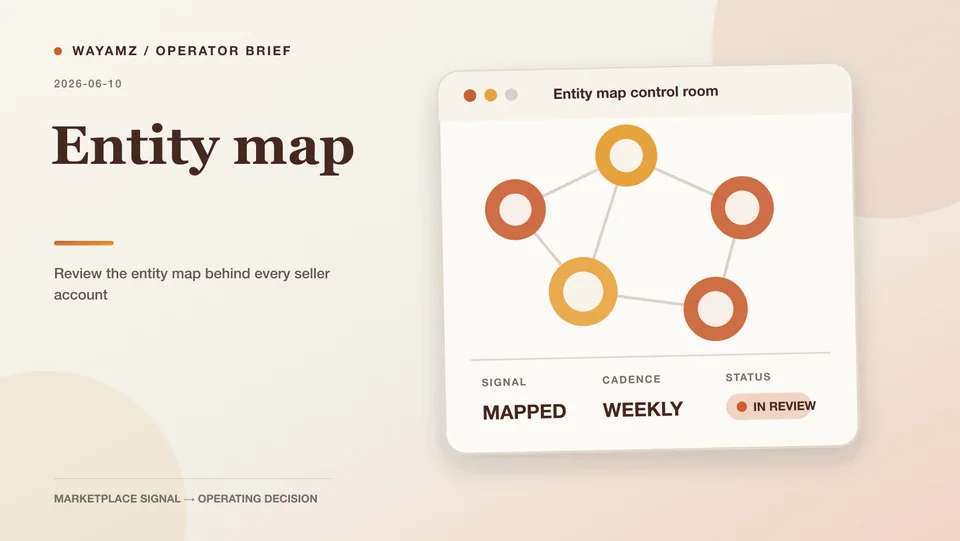
Review the entity map behind every seller account
Seller accounts, brands, bank accounts, imports, and insurance often drift across entities. A quarterly map exposes ownership and control gaps before verification.
By WAYAMZ Team
Seller accounts remember the business that existed when they were opened.
The company keeps changing.
Owners move. Entities are reorganized. Bank accounts change. A brand transfers. A new importer takes over. Insurance renews under a different legal name. Each event may be legitimate, but the combined record can become difficult to explain.
A quarterly entity review keeps marketplace identity aligned with the business operating today.
Draw the full control map
Begin with the seller account at the center.
Connect the legal entity, beneficial owners, directors or managers, operating address, primary contacts, bank account, tax registrations, brand ownership, insurance, importer role, and major service providers. Add other marketplaces that use the same entity or credentials.
Distinguish ownership from authorization. An agency may manage campaigns without owning the account. A logistics provider may import one shipment without controlling the seller. A parent company may own the brand while a subsidiary makes the sale.
The map should describe reality without forcing every relationship into one company.
Compare records field by field
Review the live marketplace data against current corporate evidence.
Check the legal name, registered address, business address, phone, email domains, identity documents, deposit method, charge method, tax interview, and user permissions. Compare Brand Registry rights and trademark ownership. Review insurance names and covered products.
Look for small mismatches that accumulate: abbreviations, old suite numbers, former employees, expired documents, or bank statements issued to a related entity.
Do not change fields simply to make them look tidy. First determine why the records differ and which value is legally and operationally correct.
Score the risk of each gap
Not every mismatch deserves an immediate account edit.
Score gaps by verification risk, disbursement risk, brand-control risk, import or tax exposure, liability, and time to remediate. A former secondary user is different from a deposit account whose owner does not match the seller entity.
Identify dependencies. Changing an address may trigger verification. Moving a trademark can affect brand roles. Reorganizing an importer may require new customs, logistics, and insurance records.
Create one remediation owner and one decision record per material gap. The team should know whether it is correcting data, changing the business, or documenting a legitimate difference.
Sequence changes carefully
Marketplace identity changes are not routine profile edits.
Consult qualified legal, tax, and marketplace specialists where ownership or entity structure is changing. Gather current documents before starting. Preserve screenshots and exports of the prior state. Notify finance, catalog, advertising, support, and logistics teams about possible interruptions.
Avoid stacking several material changes on the same day unless the platform process requires it. Verify account health, permissions, disbursements, and brand access after each stage.
Create a change packet before touching the account. It should include the reason, approved future state, current and replacement documents, affected marketplaces, dependent users and integrations, expected verification steps, cash-flow exposure, and internal communication plan. Ask an operator who was not involved in the restructuring to read the packet. If that person cannot explain why the change is legitimate and how the records connect, a marketplace reviewer may struggle too. The packet turns a corporate event into a sequence the operating team can execute and defend.
Create a rollback or escalation plan. If verification stalls, the team needs evidence and contacts ready before cash flow is affected.
Keep access aligned with control
Entity governance includes user access.
Review every administrator, agency, employee, integration, API connection, and shared credential. Remove former users and reduce permissions to the work each role performs. Keep at least two current internal administrators with protected access and documented recovery methods.
Do not let an outside operator become the only person who can explain or recover the account. Store agreements, authorization letters, and permission decisions with the entity map.
Repeat the review after acquisitions, financing, leadership changes, agency transitions, or banking changes, not only on the quarterly calendar.
The Operator Read
Account identity should not be reconstructed during a verification emergency.
Map the legal seller, owners, bank, tax records, brand, importer, insurance, and access. Compare that map with the live marketplace record and score the differences by interruption risk. Correct material gaps in a controlled sequence with proper advice and evidence.
The objective is not to make every field identical. It is to make every relationship explainable.
A seller account is infrastructure. Treat its identity with the same discipline as inventory and cash.
The Operator Brief
One email a week, operator's cut.
The week's sharpest Amazon signals from the journal — policy changes, fee math, and the data reads worth acting on. No spam, unsubscribe anytime.