
The bilingual edge: what Seattle and China each bring to your Amazon listing
Why a US-only agency misses half the work — and why a China-only agency misses the other half. A look inside how our two teams actually operate.
By WAYAMZ Team
When we tell brands we run a bilingual US-China team, the usual assumption is that it’s a cost play — cheaper labor on the China side. That’s not what it is.
It’s a capability play. The two teams do different work, and listings get better when both are in the room.
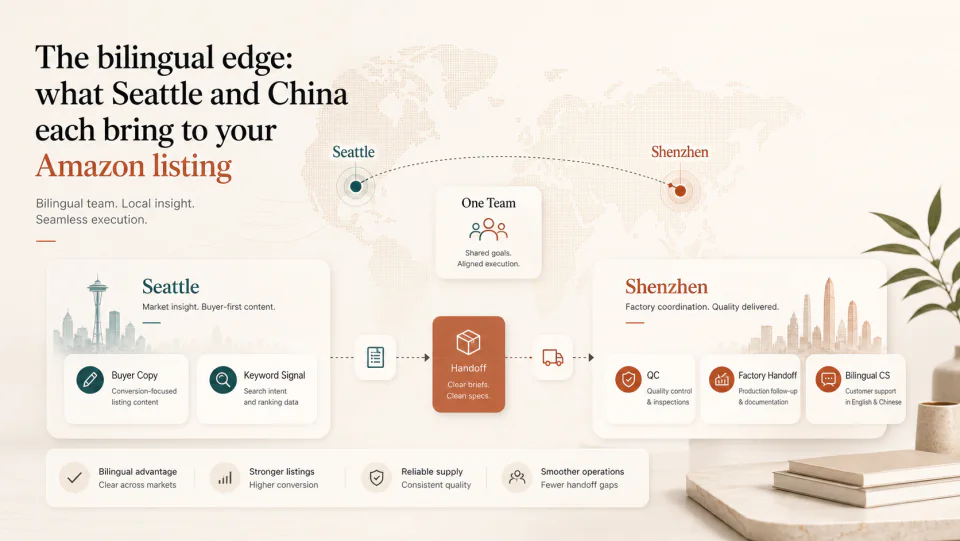
What the Seattle team does
Copy that converts American buyers. Image direction that reads as US-market premium. Keyword research rooted in how US shoppers actually search — which is often different from the direct translation of the Chinese keyword set. Brand voice work. PR and influencer strategy. Anything where the decision maker is the American consumer or an American buyer.
This team lives inside Helium 10, Data Dive, and Amazon’s own search-term data all day. They know which way category trends are moving in the US before those trends show up in backend tools.
What the China team does
Manufacturing-side coordination. Product specs, QC escalations, packaging iterations, shipment tracking, Feishu threads with the factory. Financial ops for sellers whose operations are still in RMB. Bilingual customer service for brands selling in both markets.
This team also carries something the Seattle side can’t replicate: the ability to read Chinese-market signal. What’s working on Taobao, Tmall, or Douyin often predicts what’ll work on Amazon US six months later. Watching both sides simultaneously is an edge you don’t get from a single-market agency.
Where the two teams meet
The hand-off points are where most brands lose time. A US agency sends a product-spec change request; the factory misreads it; three weeks of production get wasted. A China agency writes copy for a US listing; the copy reads as translated; conversion drops.
We avoid both failure modes by keeping the hand-off inside the agency, in one tool, in real time. The Seattle strategist writes the copy brief; the China operator translates the product-spec implications for the factory; revisions come back the same day, not the next week.
The honest tradeoff
Running two teams in two countries isn’t cheap and isn’t simple. Timezone overlap is four hours a day. Feishu and Slack both run. Documentation overhead is higher than a single-country agency.
But the brands who need us mostly aren’t optimizing for cheap. They’re optimizing for not-getting-stuck. And getting stuck — at the factory, on the listing, at US customs, during a Q4 push — is where Amazon budgets go to die.
Two teams, one agency. Wherever your business runs, someone here speaks the language.
The Operator Brief
One email a week, operator's cut.
The week's sharpest Amazon signals from the journal — policy changes, fee math, and the data reads worth acting on. No spam, unsubscribe anytime.