
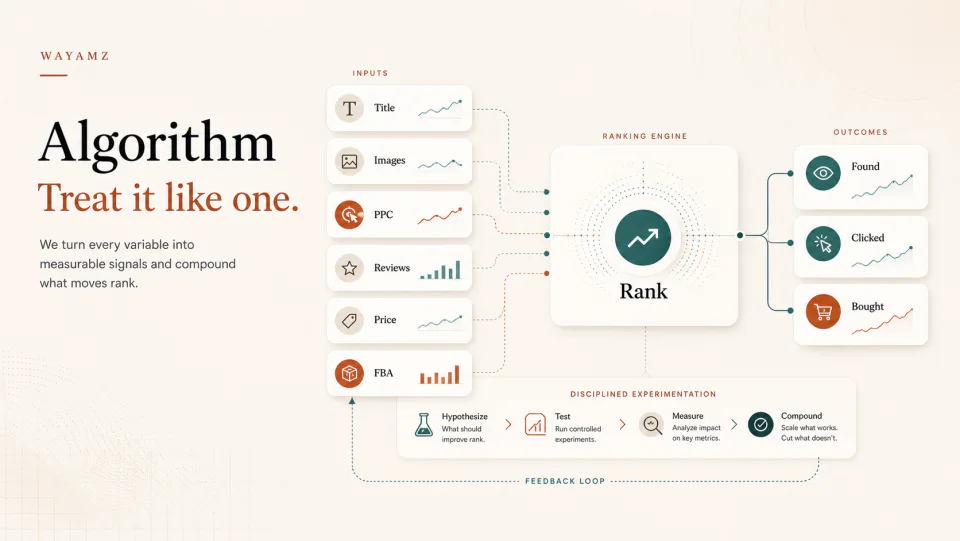
Amazon is an algorithm. Here's how we treat it like one.
Why most brands lose on Amazon isn't product quality — it's pretending the platform is a storefront when it's actually a ranking engine. Our operating thesis, unpacked.
By WAYAMZ Team
Most brands treat Amazon like a storefront. Pretty hero image, a few bullet points, maybe some lifestyle photos — ship it, wait for orders.
Amazon isn’t a storefront. It’s a ranking engine with a checkout attached.
Every listing decision — the title you write, the keywords you target, the backend search terms, the image sequence, the A+ modules, the price point, the fulfillment method — feeds a model that decides whether your ASIN shows up when someone types “standing desk.” The storefront frame makes brands optimize for what looks good. The algorithm frame makes them optimize for what gets found, clicked, and bought.
What changes when you think like an algorithm
Titles are compressed keyword manifests, not taglines. The algorithm weights the first 80 characters heavily. That’s where your brand, category, primary keyword, and top differentiator go. The remaining 120 characters are for long-tail search coverage.
Images are a funnel, not a gallery. Image 1 sells the click. Image 2 answers the #1 buyer objection. Image 3 shows scale or context. Image 4 stacks features against competitors. Image 5+ is reassurance. Every image has a specific job inside the funnel.
PPC isn’t paid traffic — it’s a research tool. A well-structured campaign tells you which keywords convert, which audiences actually buy, and which ad copy wins. The data then informs your organic listing. Treating PPC as just an ad spend wastes the signal.
Reviews are a ranking input, not a trust badge. Review velocity, sentiment, and keyword mentions in reviews all feed relevance. A 4.6-star listing with the right review language often out-ranks a 4.8-star listing that happens to have no operative keywords in its reviews.
The engineering mindset
We run every listing through the same loop:
- Hypothesize — what keyword cluster should this ASIN win?
- Instrument — set up clean tracking for search-term rank, CTR, and conversion
- Ship a change — one variable at a time
- Measure — over 10–14 days, long enough to filter noise
- Iterate or roll back
It sounds obvious until you see how most agencies operate: big redesigns shipped in a single drop, no attribution, no way to tell which change moved which number. Six months later, the listing looks different and nobody knows why performance shifted.
Algorithms reward discipline. That’s the whole game.
The Operator Brief
One email a week, operator's cut.
The week's sharpest Amazon signals from the journal — policy changes, fee math, and the data reads worth acting on. No spam, unsubscribe anytime.