
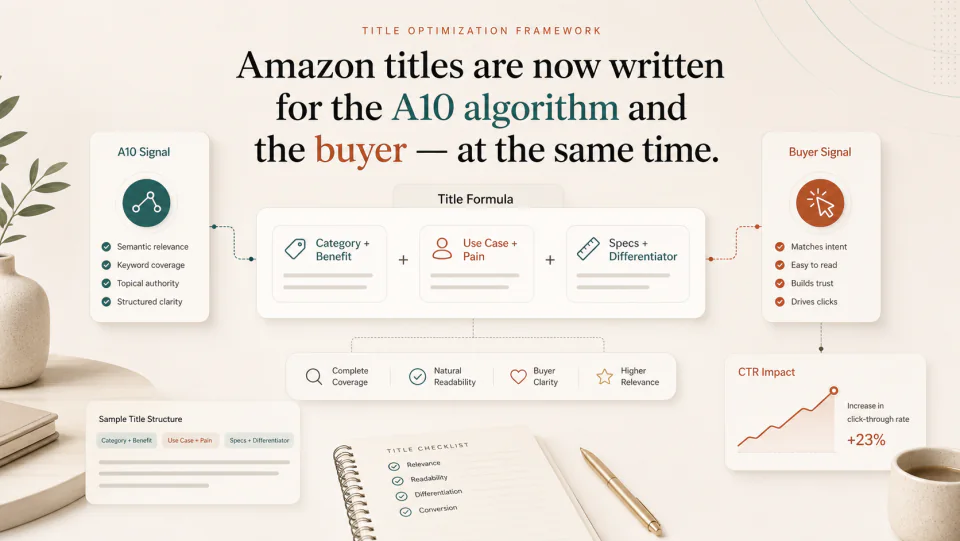
Amazon titles are now written for the A10 algorithm and the buyer — at the same time
In 2026 an Amazon listing title can no longer optimize for keywords alone, nor for readability alone. It has to satisfy both A10 and the buyer. Here's the three-part formula we use.
By WAYAMZ Team
I’ve been retesting this on live listings recently and the conclusion keeps holding: in 2026, an Amazon title cannot just optimize keywords, and cannot just read well. It has to do both — at the same time.
The underlying logic changed.
Amazon’s A10 algorithm is no longer a simple keyword-matching layer. It now reads your listing through semantic vectors — it’s judging whether your title “says a complete thing,” not just “whether a keyword appears.”
What does that mean in practice? Keyword-stuffed titles are getting down-weighted at the algorithm layer. At the same time, if your title is hard to read, buyers scan and swipe away, conversion drops, and rank falls with it.
The three-part title formula
Here’s the structure that works right now:
Part 1: Core category term + strongest benefit Tell the algorithm what you are.
Part 2: Use case + target buyer pain Tell the buyer why to care.
Part 3: Key specs + differentiating attributes Tell the comparison shopper why to stay.
What we’ve measured
On listings where we’ve switched from pure-keyword titles to “plain-spoken” versions, organic CTR recovers visibly — and organic rank doesn’t fall, because the semantic coverage actually ends up broader, not narrower.
Two questions to ask before shipping a title
- When A10 finishes parsing it, does it know what this product is?
- When a buyer finishes reading it, do they want to click?
If both answers are yes, the title is done. If either is no, keep writing.
The Operator Brief
One email a week, operator's cut.
The week's sharpest Amazon signals from the journal — policy changes, fee math, and the data reads worth acting on. No spam, unsubscribe anytime.