
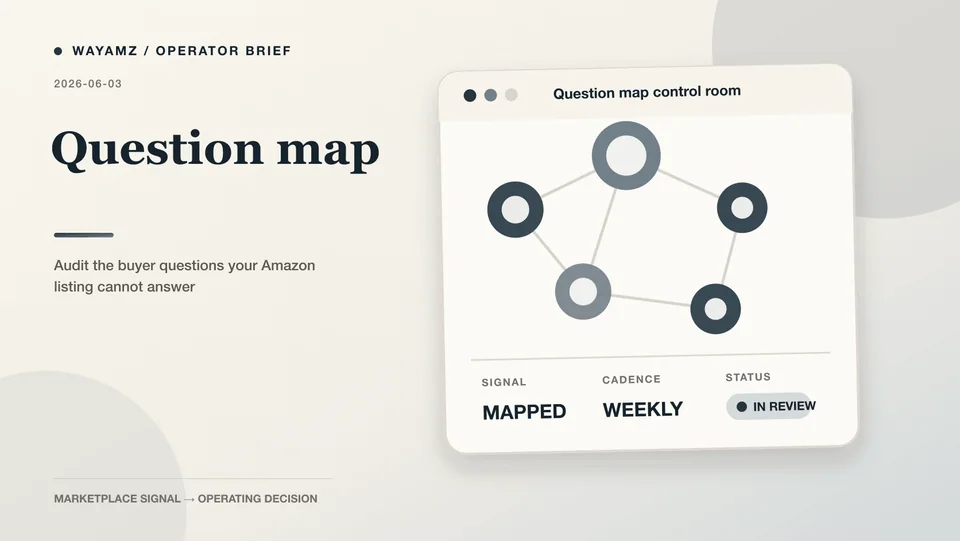
Audit the buyer questions your Amazon listing cannot answer
A polished detail page can still leave the decisive buyer question unanswered. Map question coverage across copy, images, attributes, and support data.
By WAYAMZ Team
A complete Amazon listing can still be incomplete for the buyer.
The title is filled. Every bullet has copy. The image stack looks polished. A+ content tells the brand story. Yet one practical question remains unanswered: will this product work in my situation?
That question may be about fit, compatibility, cleaning, installation, quantity, safety, or the difference between two versions. If the page does not answer it, the shopper leaves, guesses, or buys with the wrong expectation.
Question coverage is a better content standard than slot completion.
Collect questions from behavior
Do not begin with a brainstorm in a conference room.
Begin with the language buyers already use. Pull customer questions, support tickets, chat transcripts, return reasons, negative reviews, search terms, and comparison comments. Review competitor pages to see which questions their content answers clearly and which objections remain open across the category.
Keep the original phrasing. “Will this fit?” and “What size is it?” may sound similar, but they can represent different decisions. One asks about compatibility; the other asks for a measurement.
Group duplicates without polishing away the buyer’s intent. The raw language will later help the team write answers that feel natural instead of corporate.
Rank questions by commercial risk
The loudest question is not always the most important.
Score each question on purchase frequency, conversion impact, return risk, and claim sensitivity. A rare question about gift packaging may be useful. A frequent question about whether an adapter is included is operationally urgent.
Put questions into three levels:
- Decision-critical: the answer determines fit, safe use, or purchase eligibility.
- Conversion-supporting: the answer builds proof or explains a differentiator.
- Convenience: the answer improves confidence but rarely changes the purchase.
Address decision-critical gaps first. These are the gaps most likely to create expensive traffic and preventable returns.
Give every answer a primary home
Repeating the same sentence everywhere is not completeness.
Assign each answer to the content surface best suited to its job. Product identity belongs in the title. Exact technical facts belong in structured attributes and specifications. Visual fit, scale, and installation belong in images. Tradeoffs and use cases belong in bullets or A+ content. Plain-language edge cases can live in Q&A.
Then add one reinforcing signal. A dimension in an attribute should also be visible in a scale image. A compatibility statement in a bullet should agree with the model list shown elsewhere.
Primary plus reinforcement gives the buyer clarity without turning the page into repeated copy.
Write answers with boundaries
Strong listing content says where the product does not fit.
Teams often avoid limitations because they fear losing conversion. That can lift low-quality orders and create a larger return problem. A clear exclusion helps the right buyer decide faster and gives AI-assisted shopping systems a more accurate boundary.
Use literal language. Name the supported models, included pieces, operating conditions, or measurement method. Avoid broad phrases like “works with most” unless the brand can define what most means.
The answer should survive review by product, compliance, support, and the factory. If it cannot, the claim is not ready for the listing.
Measure questions that disappear
Content performance is not only clicks and conversion.
After an update, monitor whether repeated support questions decline. Watch return reasons tied to fit or expectation. Review customer questions for new gaps and inspect long-tail search terms that describe specific use cases.
CTR may fall slightly if a new limitation filters out poor-fit shoppers. That is not automatically a failure. Measure unit session percentage, return quality, review sentiment, and contribution margin together.
Run the question audit after product changes and before major traffic events. A page that worked last season may not answer the questions arriving from a new keyword or audience.
The Operator Read
The purpose of a listing is not to occupy every content slot.
It is to move the right buyer from uncertainty to a truthful decision. That requires knowing which questions carry commercial risk, where each answer belongs, and which limitations protect the customer experience.
Build the map from real behavior. Prioritize fit, compatibility, quantity, and proof. Give every critical question a primary answer and a reinforcing signal.
The best page is not the one that says the most. It is the one that leaves the right shopper with the fewest unresolved decisions.
The Operator Brief
One email a week, operator's cut.
The week's sharpest Amazon signals from the journal — policy changes, fee math, and the data reads worth acting on. No spam, unsubscribe anytime.