
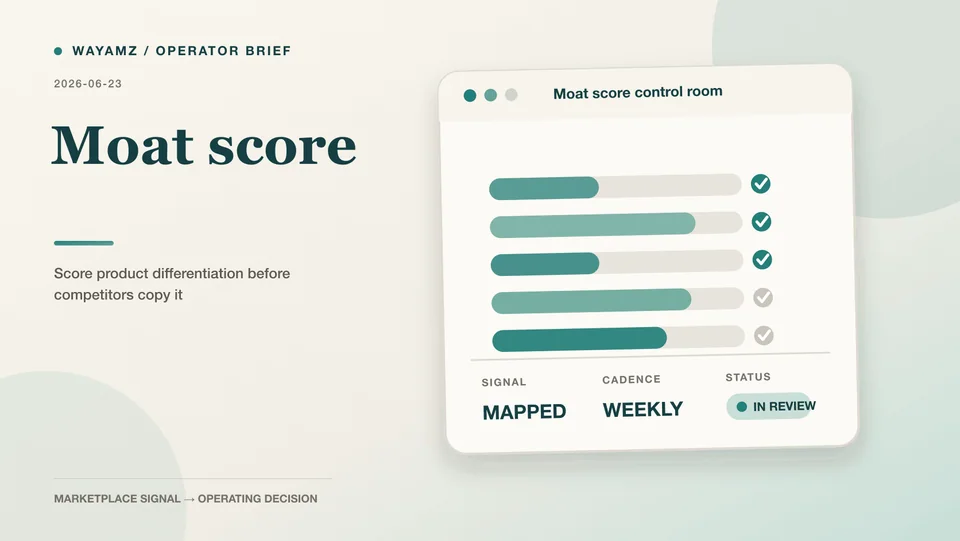
Score product differentiation before competitors copy it
Features are easy to claim and increasingly easy to match. A scorecard shows whether differentiation lives in the product, system, relationship, or story.
By WAYAMZ Team
Most product differentiation disappears when the factory opens its catalog.
Color, packaging, a bundle, and a polished listing can create a temporary advantage. They rarely create a durable one. If a competitor can match the visible offer in one production cycle, the brand needs another reason to win.
A differentiation scorecard forces the team to separate what sounds distinctive from what customers value and competitors struggle to reproduce.
List every claimed advantage
Ask product, marketing, supply chain, sales, service, and leadership separately.
Collect claims across product performance, design, materials, intellectual property, manufacturing, quality control, lead time, data, software, service, warranty, distribution, community, content, and brand meaning. Use the exact language each team believes.
Then remove duplicates and vague phrases such as “premium quality” or “customer obsessed.” Rewrite them as observable differences. For example: replacement parts ship within two business days, or a proprietary fit system reduces a known installation failure.
An advantage cannot be scored until the team can state what it changes for the customer.
Require customer evidence
Internal belief is not differentiation.
Link each claim to search behavior, conversion, willingness to pay, repeat purchase, retention, review themes, support outcomes, returns, retailer demand, or controlled product tests. Look for customers who mention the advantage without being prompted.
Distinguish acquisition value from retention value. A striking feature may earn the first click while service or reliability earns the second purchase.
Score evidence quality from assumption to repeated behavior. A focus-group preference should not receive the same weight as sustained willingness to pay across channels.
Estimate how easily it can be copied
Copy difficulty has several forms.
Estimate time, capital, tooling, engineering, data, certification, rights, supplier learning, distribution access, service infrastructure, and community trust required to match the advantage. Consider whether the competitor can bypass it with a different solution.
Patents and contracts can matter, but protection is not automatic. Ask whether enforcement is practical and whether the protected element drives the purchase.
Score the likely shelf life of the advantage. A six-month creative lead can be valuable if the team knows it is temporary and keeps the next improvement moving.
Evaluate the system around the SKU
Durability often lives outside the object.
A commodity product can become harder to replace through better fit data, installation support, replenishment, repair, creator education, channel relationships, or a product family that increases switching cost. These systems require operating discipline competitors may not reproduce quickly.
Map how the product connects to the rest of the brand. Does it introduce customers to higher-value items? Does it generate useful data? Does it earn retailer access? Does it make the community stronger?
Include failure recovery in the system score. Two products may work equally well on day one, while only one brand stocks replacement parts, diagnoses issues accurately, and resolves claims without making the customer start over. That capability can create retention and channel trust, but it must be measured. Review resolution time, replacement success, support cost, repeat purchase after a problem, and the product changes generated from service data. A support team that only apologizes is an expense; a recovery system that retains customers and improves the product can be differentiation.
Do not use system value to hide a SKU that destroys cash. Strategic roles still need explicit limits.
Choose a product role
The scorecard should end in a decision.
High customer value and high copy difficulty justify investment. High value with low durability requires a faster innovation and content cadence. Low value with high complexity may indicate the team built something customers do not need. Low value and low durability is a harvest, reposition, or exit candidate.
Assign a roadmap to strengthen one or two dimensions rather than inflating every score. Set a review date and competitor trigger.
If the product remains a commodity, price and operate it honestly. Do not spend brand budget pretending the moat exists.
The Operator Read
Differentiation is not the number of features listed in the fifth image.
It is customer value that survives comparison and takes meaningful effort to reproduce. Score the evidence, copy difficulty, and system around the SKU. Then decide whether to invest, strengthen, harvest, reposition, or stop.
Competitors will copy visible wins. The operating advantage is knowing which wins are temporary and building the next layer before the market catches up.
A scorecard does not create a moat. It keeps the team honest about where one exists.
The Operator Brief
One email a week, operator's cut.
The week's sharpest Amazon signals from the journal — policy changes, fee math, and the data reads worth acting on. No spam, unsubscribe anytime.