
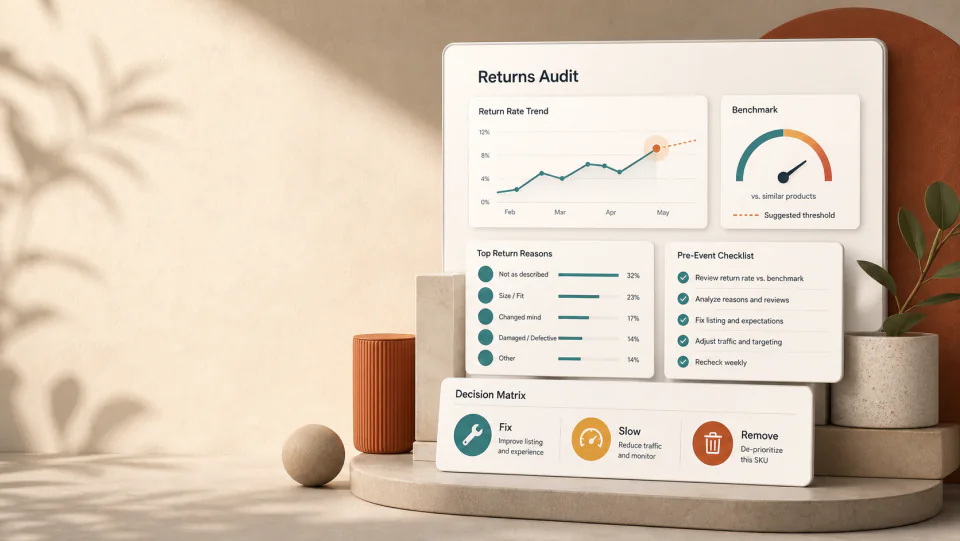
Audit Amazon's 'Frequently returned item' risk before June traffic arrives
Amazon now puts return-risk language directly on some product detail pages. Before June demand picks up, audit which ASINs are closest to that threshold and decide what to fix, pause, or de-prioritize.
By WAYAMZ Team
Amazon has turned returns into front-end merchandising.
That is the real meaning of the Frequently returned item badge.
When that warning appears on a product detail page, the problem is no longer sitting quietly in an operations report. It is visible to the shopper before the order is placed. For sellers, that changes the timing of the work. A return-rate issue is no longer something to diagnose after a promotion. It is something to audit before the next traffic wave arrives.
That matters more in May 2026 because Amazon has already confirmed Prime Day will move into June 2026, which compresses the repair window for any SKU that is likely to absorb heavier sessions, broader keyword coverage, and more first-time buyers.
What changed
Amazon has publicly described the “Frequently returned item” badge as one of the features it uses to help customers make better purchase decisions. Seller-facing guidance is more useful operationally: badging is tied to how an ASIN’s return rate compares with similar products, and the Voice of the Customer workflow shows both your return-rate history and the suggested rate to avoid badging.
The practical takeaway is simple. Stop looking for one magic percentage that applies to every catalog. A home product, an apparel item, and an electronics accessory will not all live under the same return-rate ceiling. The correct question is:
Which of our priority ASINs is drifting above the category-normal range, and why?
That is a much better operating question than waiting for a visible badge and then trying to reverse-engineer the cause.
Why it matters
The badge does not create the underlying problem. It exposes it.
If buyers are returning an item because the size is unclear, the material feels different than expected, the bundle contents are misunderstood, or promo traffic is bringing in the wrong shopper, those issues already existed. The badge just moves the cost forward by putting a warning directly in the conversion path.
That is why May is the wrong month for optimism and the right month for triage. June event traffic does not behave like normal traffic. It usually brings:
- More top-of-funnel shoppers
- More price-sensitive clicks
- More low-context buyers landing on hero ASINs
- Less tolerance for unclear images, sizing, compatibility, or expectation setting
If a SKU is already near its category-relative return threshold, a traffic spike can turn a manageable issue into a visible merchandising problem.
The practical workflow
This audit does not need to be complicated, but it does need to be weekly.
Start with the ASINs that matter most for June: hero SKUs, high-ad-spend SKUs, products carrying your branded search volume, and any listing expected to take promo traffic. Pull Voice of the Customer, the Customer Returns Report, and recent review patterns for that group.
Then sort each SKU into one of four buckets:
- Expectation gap. Returns cluster around size, fit, color, compatibility, or “not as described.” This is usually a detail-page problem first. Main image, comparison table, dimensions, bullets, and A+ content need to close the gap before more traffic arrives.
- Quality or packaging problem. Returns cluster around defect, breakage, leakage, or missing parts. This is not a copywriting exercise. Slow traffic, inspect inventory, and push the root cause upstream.
- Traffic-quality problem. Return rate rose after coupons, broad-match expansion, or off-angle promo placement. The product may be fine; the buyer mix is not. Tighten traffic before blaming the SKU.
- Chronic risk SKU. The ASIN has been unstable across multiple weeks and still requires explanation every time the team reviews it. Remove it from the June hero plan and protect healthier products instead.
The goal is not to write a long report. The goal is to force a decision.
Immediate actions
For most teams, the next 72 hours should end with a short list of decisions:
- Rewrite the main image and first screen for any SKU where return reasons show an expectation mismatch.
- Add hard-spec language wherever shoppers are confusing size, quantity, material, or compatibility.
- Reduce paid traffic on ASINs with unresolved quality or packaging problems.
- Remove unstable SKUs from June promotion plans instead of trying to “advertise through” a return issue.
- Re-rank the hero list so budget and inventory flow toward products with healthier post-purchase behavior.
This is also a good place for a lightweight AI workflow. An agent can summarize return reasons, group negative-review language, and flag which ASINs moved closest to the suggested threshold. The decision still belongs to the operator. The machine just shortens the time between signal and action.
The operator read
Many Amazon teams still treat returns as a back-office metric. That is outdated.
Once Amazon surfaces return risk on the product page, returns become part of merchandising, conversion, and event planning. The teams that handle June well will not be the ones with the biggest discount calendar. They will be the ones that enter the month with a cleaner hero list, tighter expectation setting, and fewer SKUs that need traffic to hide a product problem.
Before June traffic arrives, every important ASIN should have a label of its own:
- safe to scale
- fix before scale
- do not feature
That is the audit that protects conversion when the market gets louder.
The Operator Brief
One email a week, operator's cut.
The week's sharpest Amazon signals from the journal — policy changes, fee math, and the data reads worth acting on. No spam, unsubscribe anytime.