
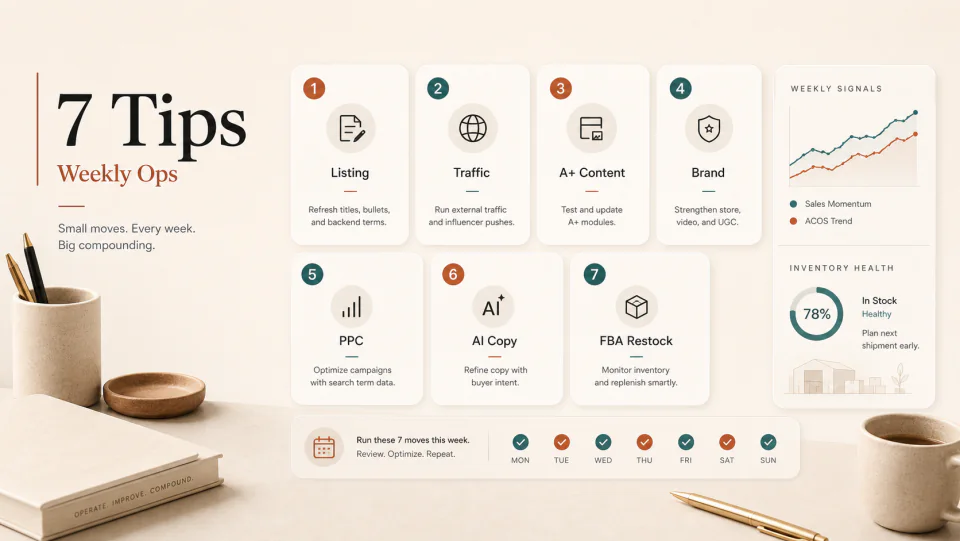
Seven Amazon US operating tips worth running this week
Write listings for AI and buyers at once, treat external traffic as a funnel instead of a link, and stop equating 'a lot of ads' with 'a real brand.' Seven tactics, no theory.
By WAYAMZ Team
Seven tactics we’ve been running on Amazon US this past week. Each one is operational — something a team can act on tomorrow.
1. Write listings for the AI and the buyer in the same breath
Rufus and Cosmo are re-parsing your listing continuously. Bullet points should answer “what problem does this product solve, and for whom” — not just enumerate specs. Context + pain point + differentiator. All three, not one.
2. Treat external traffic as a funnel, not a link
Affiliate and creator-driven traffic isn’t “find an influencer, drop a link.” The real structure is four layers: discovery (creators learn about you), demand creation (content shifts purchase intent), conversion infrastructure (attribution and tracking), feedback (what’s converting feeds back into the next brief). Sellers who stop at layer one lose most of the value.
3. A+ Content is failing for a specific reason
Static pretty imagery isn’t enough anymore. Buyers in comparison-shop mode bounce if A+ doesn’t contain a comparison table, real-use scenarios, or pointed answers to their pain. In 2026, A+ earns its slot by being substantive — not decorative.
4. Stop selling products. Start building a brand.
Listings with A+, a Brand Story, and external traffic have broader algorithmic indexing, lower ad CPCs, and stronger conversion. On Amazon US in 2026, the gap between “brand operators” and “product operators” is widening every quarter.
5. High-ticket PPC: buy data before you compress cost
On $300+ AOV products, high ACoS in the launch window is expected — you’re buying data. Set a loss ceiling, run auto campaigns to harvest long-tail search terms, then after three to six months migrate the high-converting terms into precise SP campaigns. Compressing budget in month one is the classic mistake.
6. AI copy needs specific prompts, not generic ones
When you use AI to rewrite a listing or draft ad copy, the specificity of the prompt determines the specificity of the output. Feed it: the target buyer profile, the most common negative-review themes for competitor products, and your own core differentiators. Vague prompts produce vague outputs — every time.
7. Forecast inventory early. Stockouts hurt longer than you think.
When FBA inventory runs short, ad weight drops, rank falls, and recovery takes two to four weeks. Late March and April are peak-season restock windows. Lock the Q2 restock calendar now, not when the stock page turns yellow.
The Operator Brief
One email a week, operator's cut.
The week's sharpest Amazon signals from the journal — policy changes, fee math, and the data reads worth acting on. No spam, unsubscribe anytime.